

The idea that individual investors cannot outperform the market is widespread—and often justified. The problem, however, is not that outperformance is impossible, but that it requires a disciplined process, sound analytical judgment, and the right tools. This course, together with its companions, is designed to develop exactly those capabilities: to help you analyze companies more rigorously, make better-informed decisions, and build an investment process aimed at outperforming the relevant benchmark over time.
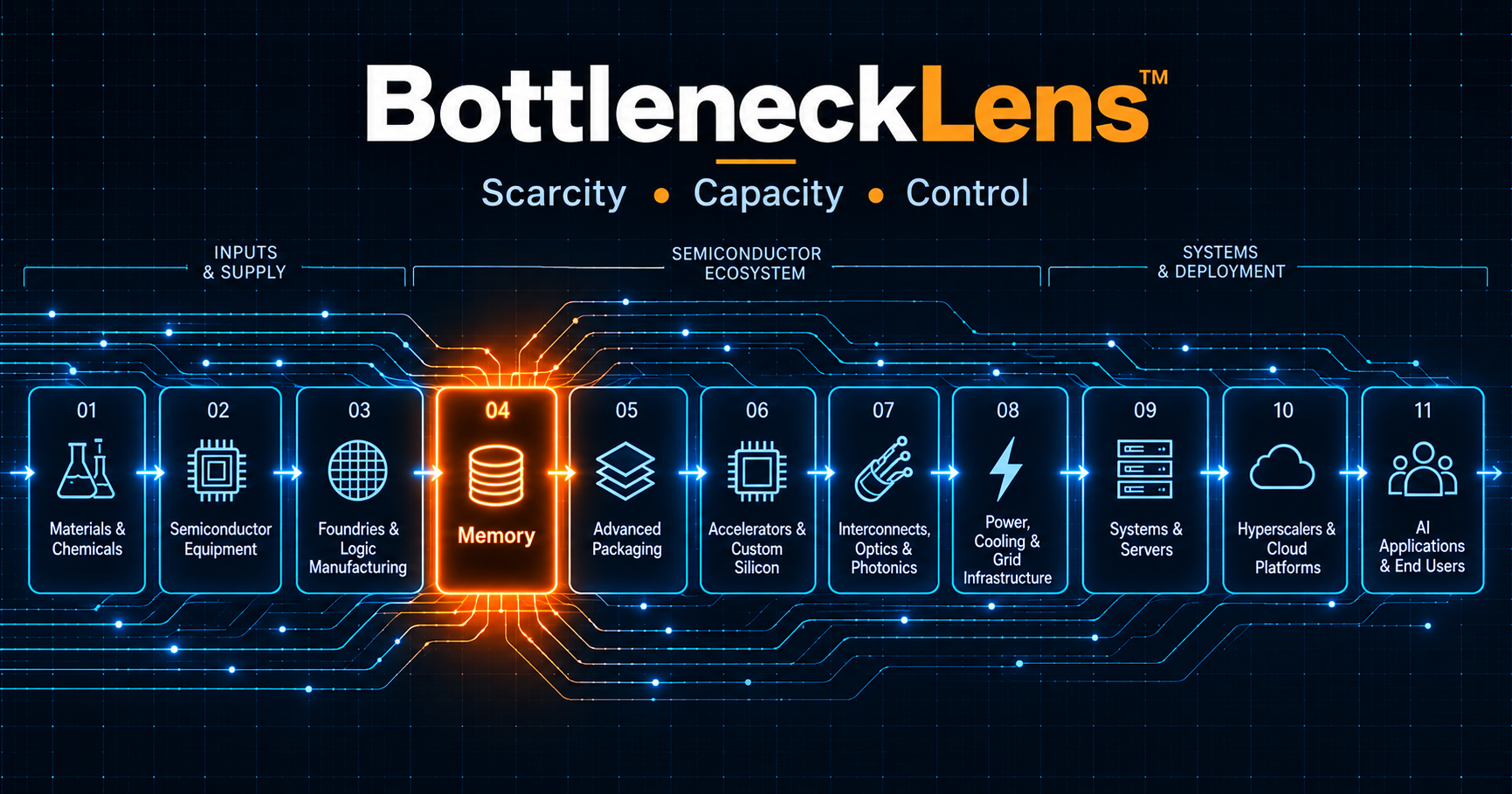
AuditAlpha™ is Your Science’s systematic stock-analysis engine. It comprises three analytical frameworks, one per investment horizon: PulseLens (weeks to months), BottleneckLens (six to twenty-four months) and CompounderLens (ten years and more). Their methods differ, but they share the same principles: structured data retrieval, explicit decision rules, documented reasoning and a complete audit trail.
The central purpose of the course is to develop a rigorous, transferable method for analyzing structural bottlenecks. Participants learn how to identify scarcity, test its durability, assess competitive and substitution risks, interpret the relevant financial and industry evidence, and recognize when an investment thesis is strengthening or deteriorating. AuditAlpha™ BottleneckLens is used as a practical demonstration environment, showing how these judgments can be organized into a systematic and auditable process. The underlying analytical skills remain fully applicable independently of the software.
Contents
The course is organized in three parts that build on each other.
I. The first part lays the methodological foundation:
what makes a bottleneck, and how ten criteria organized in three layers (Moat, Timing and Risk) turn that question into a verifiable assessment. Each criterion returns a PASS, FAIL or CONDITIONAL verdict with a confidence level, and the verdicts roll up into Moat and Timing scores.
1. Identifying a Bottleneck: The Initial Assessment
1.1. What Makes a Bottleneck: Ecosystems, Chokepoints and Pricing Power
1.2. The Moat Layer
1.3. The Timing Layer
1.4. The Risk Layer
1.5. Verdicts, Confidence Levels and the Moat and Timing Scores
1.6. The Verdict Table and the Internal Grade
1.7. The Analyst’s Role: Reviewing and Adjudicating the Evidence
II. The second part covers the risk-management suite that runs every week after entry:
the three-tier Technical Status model, the Peak Psychology module and its three signals, the Daily Briefing, and the monthly Bubble Signal Checklist. You will learn to read their outputs and to understand why each signal is weighted as it is, without any involvement in coding.
2. Monitoring a Position: The Risk-Management Suite
2.1. Technical Status: Institutional Selling, Structural Confirmation and Price Action
2.2. Peak Psychology: Good-News Rejection, Estimate Dispersion and Options Positioning
2.3. The Daily Briefing: Connecting News to Thesis Assumptions
2.4. The Bubble Signal Checklist: Systemic Risk Across an Ecosystem
2.5. Persistent History: Reading a Position’s Trajectory
2.6. Operating the BottleneckLens Engine
III. The third part investigates practical application:
it applies the framework to case studies at past decision dates, including the full monitoring history that followed each initial assessment.
3. Case Studies at Past Decision Dates
3.1. The AI Infrastructure Chain: Compute, Memory, Optics, Power and Cooling
3.2. Case study 1 – e.g., TSMC
3.3. Case study 2 – e.g., MSFT
3.4. Case study 3 – e.g., GOOGL
Format & Delivery
- Online delivery via Microsoft Teams
- 8 sessions of 2 hours (e.g., 10:00-12:00 or 15:30-17:30), structured as 3 + 3 + 2 across 4 weeks
- Over 100 pages of professionally written lecture notes covering methodology, case studies, and engine operation
- Limited class size to ensure individual attention
- Course-related support by email, with brief follow-up calls available at the instructor’s discretion
- Instructor: Prof. Norbert Poncin – founding director of the Department of Mathematics and First Chief Scientist at the University of Luxembourg, with extensive experience in mathematical modelling, statistical analysis, and research consultancy
- Educational access to AuditAlpha™: Once the AuditAlpha™ platform is successfully launched and can be offered under the applicable regulatory framework, course participants will receive six months of free access to its educational version for practice and course-related exercises, subject to fair-use limits. The course itself is complete without it.
The next session will be scheduled in consultation with participants once the first 5 enrollments are confirmed.